
About Collabo-Gleaning
The Collabo-Gleaning Framework is a new, research-backed model designed to empower STEM educators with practical, relational, and sustainable strategies for building the capacity to secure external funding.
This site distills the study’s insights, tools, and recommendations into a user-friendly resource for educators, administrators, and institutions seeking a more supportive and successful funding ecosystem.


Our Mission
Our mission is to help early-career higher education faculty reframe success as capacity built, not just grants won.
Too many early-career faculty label a “no” as failure. We count the wins you can control: building relationships, sharpening skills, and taking deliberate steps toward funding with each submission.
Trying to get funding can sometimes feel impossible when you're busy with a full or overloaded schedule, especially with the lack of people around to help since COVID.
Early-career STEM educators at non-R1 colleges and universities face unique challenges in pursuing external funding — limited time, limited resources, and limited guidance. Yet external grants are more critical than ever as higher education grapples with shrinking budgets and increased competition.
Why External Funding Has Become Essential
Across public and private institutions, higher education is experiencing unprecedented financial strain:
Decreasing state support
Increasing tuition dependence
Declines in high school graduates
Rising scholarship discount rates
Private colleges closing at a rate of one per week
As a result, universities are turning toward external funding to support research, innovation, and academic stability. However, many non-R1 institutions lack the robust infrastructure — grant offices, experienced support staff, writing resources — that help faculty pursue funding successfully. Early-career STEM educators at these institutions often describe the funding landscape as a mystery. This project aims to change that.

What helped the most?
“Collaboration to help write different sections of the grant and to brainstorm ideas”
“Collaborating with colleagues who had successfully pursued and [been] awarded grants in the past”
What’s your advice?
“Find and join an existing, successful team”
“Collaborate with colleagues from other institutes that have [a] strong track record of getting grants and have a bigger grant writers support office”
Quotes from real STEM educators about our study...
Findings
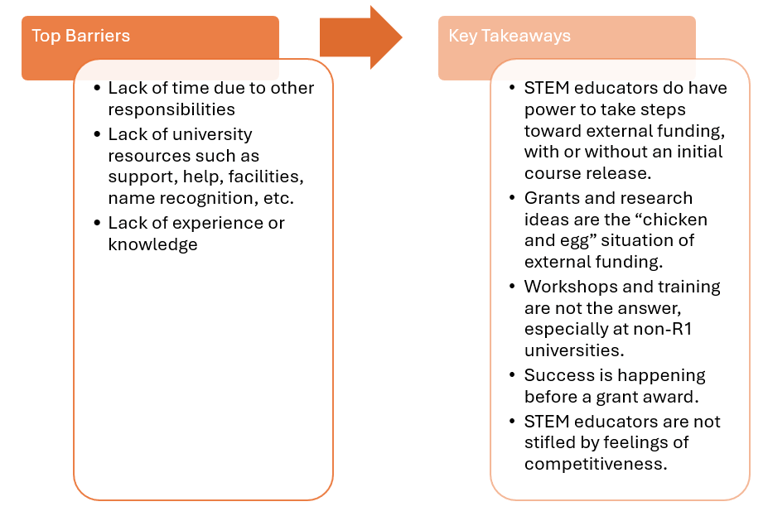
For more details, see our full paper: Unveiling the mystery: A capacity development framework for early-career STEM educators pursuing external funding
© 2025. All rights reserved.